Updates
Beyond the law: Accelerating access to justice to end female genital mutilation
23 Mar 2026
NEW YORK, United Nations – “A law that exists only on paper does not create justice – it creates the illusion of justice,” said Fozzia Aden, a lawyer and survivor of female genital mutilation, at the 70th Session of the Commission on the Status of Women (CSW70) in New York on 13 March 2026.
She spoke at a high-level side event entitled “Female genital mutilation laws and human rights principles: Ensuring access to justice for all women and girls,” which was co-hosted by the Governments of Burkina Faso and Italy, in collaboration with Canada, Eritrea, Sweden, The Girl Generation consortium and the UNFPA-UNICEF Joint Programme on the Elimination of Female Genital Mutilation.
With only four years left to achieve the Sustainable Development Goal (SDG) of eliminating female genital mutilation, the event highlighted a critical paradox: While 59 countries have now enacted legal bans against the practice, serious challenges remain – from enforcement to cross-border loopholes and lack of buy-in due to deeply entrenched social norms.
The implementation gap
Although the global community has made significant strides, many speakers warned that legal frameworks are the foundation for change, rather than change itself. “Justice can be an abstract thing,” said UNFPA Deputy Executive Director for Programme, Pio Smith.
“Behind every statistic is a girl. Securing laws is only one step. Our ultimate goal is universal access to justice, where every girl at risk can seek protection and every survivor can access support.”
Sheema Sen Gupta, Director of Child Protection at UNICEF, noted that formal law enforcement alone can in fact drive the practice underground. She instead advocated for laws to work in tandem with customary and religious justice mechanisms to shift social conventions from within.
National successes and emerging threats
The event showcased powerful evidence of progress when political will meets grassroots mobilization. For example, between 2014 and 2020, prevalence rates in Eritrea among girls under age 15 dropped from over 18 per cent to just 2.3 per cent, noted the Permanent Representative of the State of Eritrea to the UN, Sophia Tesfamariam.
Indonesia, recently integrated eliminating female genital mutilation into its National Development Plan, and issued regulations prohibiting health workers from performing the practice, including the so-called ‘medicalized’ version.
And in Burkina Faso, ‘mobile courts’ have proved successful in bringing justice systems directly into rural communities
But despite these gains, experts from the World Bank and OHCHR raised alarms regarding the increased practice of parents taking girls abroad to be subjected to female genital mutilation during school holidays, in other countries where law enforcement is weak or non-existent. This disturbing transnational trend underscores the need for coordinated, cross-border legal cooperation against it.
A survivor-centred future
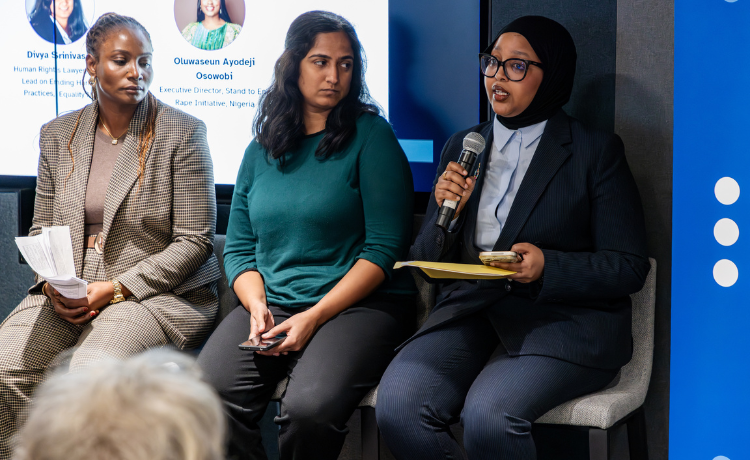
The most poignant moments of the afternoon came from activists on the front lines. Fatou Baldeh, founder of Women in Liberation and Leadership in The Gambia, spoke of the “painful contradiction” whereby girls undergo female genital mutilation despite legal bans. “Real justice is when a girl is protected long before the law is ever needed,” she added.
Divya Srinivasan, of the NGO Equality Now, and Oluwaseun Ayodeji Osowobi, of Nigerian NGO Stand to End Rape Initiative, emphasized that justice systems must stop re-victimizing survivors. Currently, data show that in some regions over 55 per cent of those prosecuted under laws against female genital mutilation are the survivors themselves or their family members, rather than practitioners.
As the session concluded, the message was clear: Ending female genital mutilation is a goal that governments must fund and enforce. Italy, for example, reaffirmed its commitment as a leading donor in this area, having invested nearly €43 million in the UNFPA-UNICEF Joint Programme since 2008.
But more support is needed. “We are waiting to see if we will put our words into action,” said Jacinta Muteshi Strachan, team lead of The Girl Generation, in her closing remarks. “Justice must not remain a promise written in policy documents. It must be a lived reality for every girl.”
The event ended with a collective call to increase the pace of progress, which is at risk of backsliding due to increased geopolitical volatility and severe funding cuts to initiatives such as the UNFPA-UNICEF Joint Programme. In the final stretch towards the SDGs, this programme is currently faced with a funding gap of more than $160 million. Ensuring long-term commitments and a diverse group of committed partners and donors will therefore be critical to eliminate female genital mutilation by 2030.
Despite the challenges, the global movement remains resolute: Justice will be served only when the most vulnerable girl in the most remote village knows that her body belongs to her alone.
Watch the event recording here.