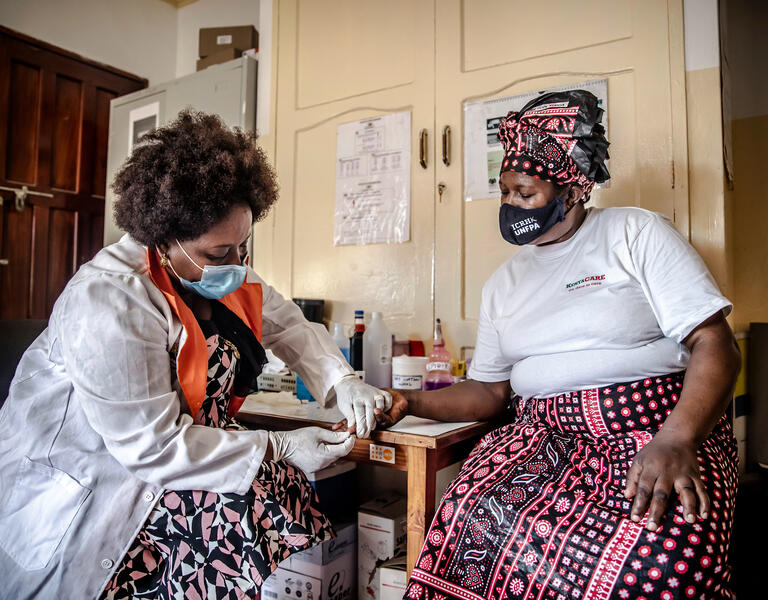
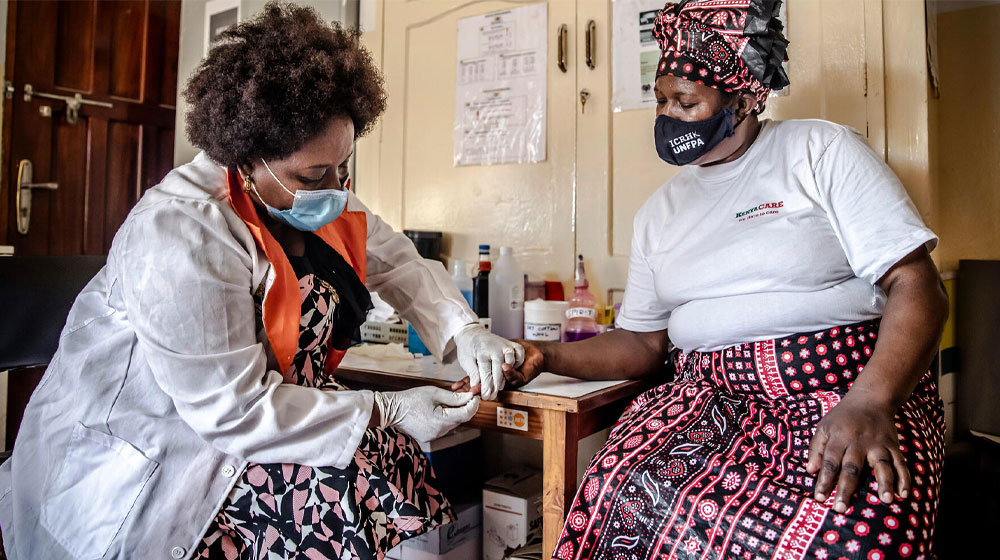
Through its work on sexual and reproductive health and rights, UNFPA aims to increase access to new HIV prevention innovations, medicines and commodities such as condoms. UNFPA also supports integrated health services and comprehensive sexuality education for young people, and addresses the harmful social norms, gender inequalities, violence, stigma and discrimination that increase vulnerability to HIV. This work places women and girls, young people and key populations at the centre of the response.
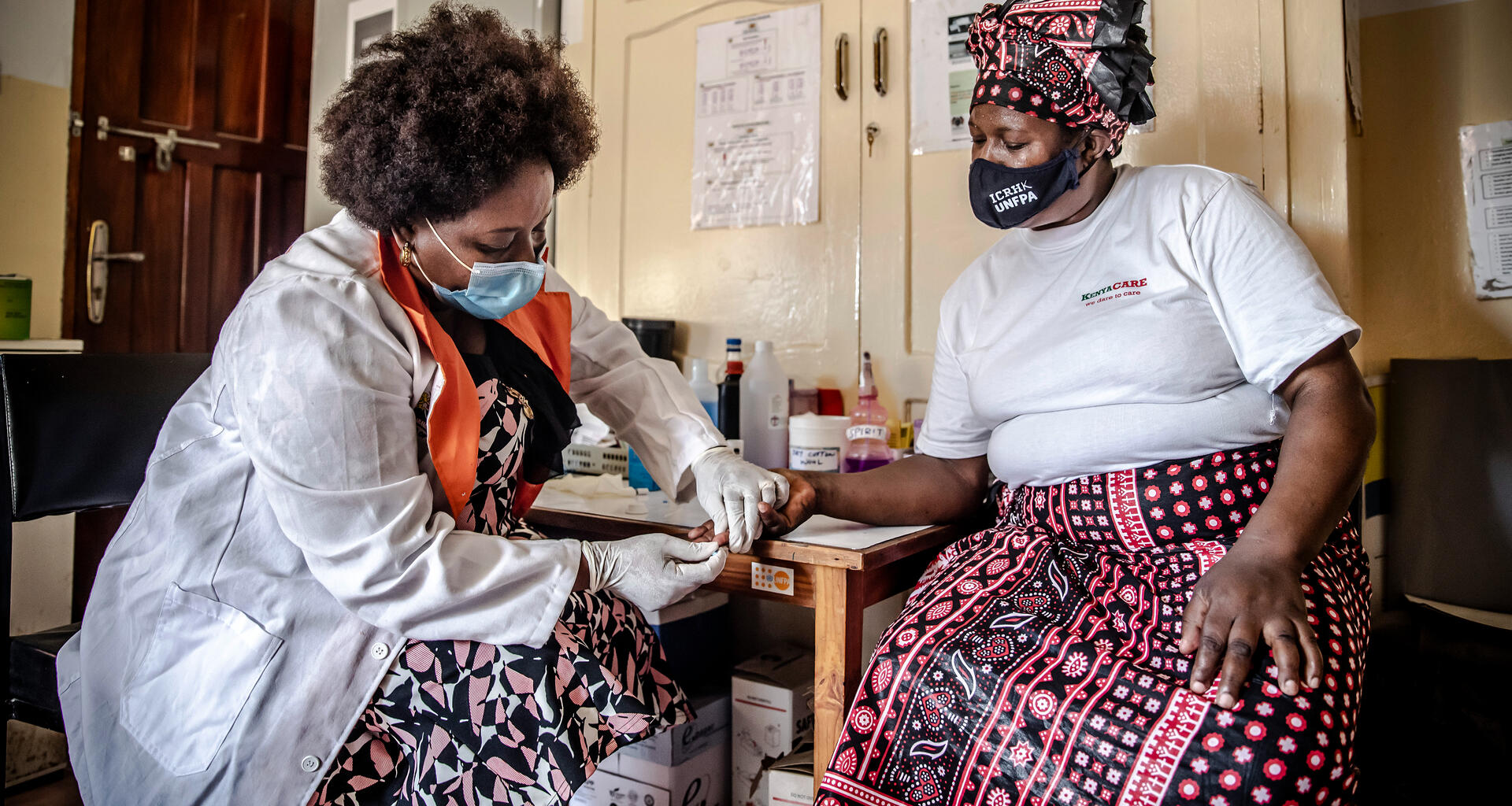
The global response to HIV represents one of the greatest public health and human rights achievements of recent decades. Since 2010, new HIV infections have fallen by 42 per cent globally, and AIDS-related deaths by 57 per cent. These advances are a powerful demonstration of what sustained political commitment, scientific innovation, integrated sexual and reproductive health services and community leadership can achieve.
Nonetheless, this progress has not been equal: In sub-Saharan Africa, adolescent girls and young women acquire HIV at three to four times the rate of their male peers, and women account for six out of ten new infections. Previous gains are being threatened by a severe funding crisis, and the world is not on track to reach the global goal of ending AIDS by 2030. Around 41 million people still live with HIV worldwide, in 2025 an estimated 1.2 million people were newly infected, and infection rates are reported to be rising in a number of regions.
Globally, almost half of new HIV infections occurred among key populations and their sexual partners. Young key populations include young men who have sex with men, transgender adolescents and young people, young people who sell sex, young people who inject drugs, and adolescents in prisons and other closed settings. Yet all these groups continue to face stigma, discrimination and criminalization that limit their access to HIV prevention, treatment and care.
In June 2026, UN Member States adopted a Political Declaration on HIV and AIDS, which sets the global targets and commitments that will guide the response through 2030. These include reaching 90 per cent of people in need with effective HIV prevention options, while advancing human rights and gender equality, strengthening community leadership and securing sustainable financing. UNFPA is committed to translating these commitments into action by expanding prevention choices, integrating HIV response within sexual and reproductive health services, supporting the introduction of new prevention technologies and medicines and tackling the structural inequalities that continue to drive HIV risk.
The work to end AIDS remains unfinished, but it is possible to usher in a new era of HIV prevention grounded in respect for human rights, individual choice and bodily autonomy.
Ending AIDS requires addressing the inequalities that shape HIV risk and limit access to prevention, treatment and care. Gender inequality, violence, stigma, discrimination and punitive laws can restrict people’s autonomy and deter them from seeking support. Globally, only around half of women and girls aged 15–49 are able to make their own informed decisions about sexual relations and healthcare, while criminalization of sex work, same-sex relations and HIV transmission continue to create barriers for key populations. Persons with disabilities also continue to experience increased vulnerability to HIV, and conversely, having HIV may increase the possibility of developing disabilities.
UNFPA is addressing these structural barriers by promoting bodily autonomy and gender equality, challenging harmful gender norms, engaging men and boys, strengthening responses to gender-based violence and supporting non-discriminatory, rights-based services and legal environments. Community leadership and the meaningful participation of those most affected are central to this work.
UNFPA leads work on combination HIV prevention, with a particular focus on women and girls, adolescents and young people and key populations. This includes expanding access to condoms and new prevention options, and integrating these as well as testing and care into sexual and reproductive health services. UNFPA’s work is guided by the Global AIDS Strategy 2026–2031 and the HIV Prevention 2030 Global Access Framework, and is aligned with the UNFPA Strategic Plan 2026–2029.
HIV prevention is entering an exciting new era of innovation and choice. Long-acting pre-exposure prophylaxis medications are expanding rapidly, including injectable cabotegravir and lenacapavir. These advances have the potential to transform HIV prevention by giving people a wider range of options that better fit their lives, needs and preferences. UNFPA supports countries to prepare for and introduce new prevention methods through integrated sexual and reproductive health services, while ensuring that established options such as condoms and oral pre-exposure prophylaxis remain accessible.
This opportunity comes at a time of severe pressure on HIV prevention programmes. Funding cuts have extensively disrupted condom procurement and distribution, HIV testing, prevention and community awareness programmes. UNFPA is responding by supporting countries to make better use of available resources, channel domestic financing and integrate HIV prevention within sustainable sexual and reproductive health systems.
UNFPA brings together HIV prevention with its wider mandate on family planning, maternal health, gender-based violence and adolescent and youth development, while addressing the inequalities, stigma and discrimination that continue to drive HIV risk and limit access to services. Below are details on UNFPA’s work:
- Maternal and newborn health and well-being: UNFPA supports integrating prevention of HIV and sexually transmitted infections within maternal and newborn health services, including HIV and syphilis testing, access to a range of prevention options, treatment and care. This helps women and parents at higher risk to remain HIV-negative, supports the health and well-being of those living with HIV, and contributes to eliminating vertical transmission of HIV and other sexually transmitted infections.
Key successes include Ethiopia, where integrated maternal health platforms test pregnant women for HIV and provide prevention of mother-to-child transmission services, and Tajikistan, where national guidelines on preventing mother-to-child transmission have been successfully integrated into primary healthcare. Maternal HIV and sexually transmitted infections are a significant contributor to the global burden of 1.9 million stillbirths annually. Embedding tests and counselling for HIV and sexually transmitted infections into health platforms is therefore a critical step towards the triple elimination agenda and improving newborn survival. Furthermore, while an estimated 257 million women cannot access the safe, modern contraceptive options they would like, services such as these actively promote condoms alongside long-acting reversible contraceptives.
- Comprehensive sexuality education: UNFPA supports countries to provide age-appropriate, quality, rights-based comprehensive sexuality education in and out of school. This helps equip young people with the knowledge and skills to make informed choices about their bodies, relationships and sexual and reproductive health, including how to prevent HIV and other sexually transmitted infections. UNFPA also works to connect sexuality education with youth-friendly sexual and reproductive health services, so that information is matched by access to prevention and care.
UNFPA has global flagship comprehensive sexuality education programmes that reach young people furthest left behind, such as key populations, people living with HIV, people living with disabilities, indigenous and geographically isolated people and people in humanitarian settings.
- Working with the Global Fund to fight HIV, tuberculosis and malaria: UNFPA partners with the Global Fund to integrate sexual and reproductive health and rights and maternal and newborn health interventions into national HIV, tuberculosis and malaria response. Operating across national, regional and global levels, UNFPA provides targeted technical assistance, facilitates stakeholder-country dialogues and supports national proposal development teams.
- Humanitarian work: UNFPA supports HIV prevention, testing and treatment in humanitarian and fragile settings by implementing the Minimum Initial Service Package for Sexual and Reproductive Health in Crisis Situations. This package aims to ensure the availability of condoms at the community level, supports precautions to prevent and control infections, ensures safe blood transfusions in health facilities, and provides post-exposure prophylaxis. The package also focuses on the continuity of antiretroviral therapy for affected populations.
- Marginalized populations and systemic barriers: Key populations continue to face much higher risks of acquiring HIV, while also experiencing some of the greatest barriers to prevention, testing and treatment. Criminalization, stigma, discrimination, violence and exclusion from health services can make it difficult – and sometimes unsafe – to seek care. UNFPA works with communities and governments to remove barriers and expand access to rights-based, people-centred HIV and sexual and reproductive health services. This includes supporting community-led and peer-based initiatives; strengthening links to pre- and post-exposure prophylaxis, condoms, HIV and sexually transmitted infection testing and treatment; and developing digital and other approaches that reach people who may be excluded from mainstream services. Across regions, this work is adapted to local realities, but the principle is the same: People most affected by HIV must be able to shape and access the services they need, free from stigma and discrimination.
Updated 25 September 2026